


White Label ATMs (WLAs) have emerged as a significant component of modern banking, transforming how transactions are conducted. Unlike traditional ATMs, which are primarily operated by banks, WLAs are owned and managed by non-bank entities. This article will explore the development of WLAs in India, their regulatory framework, and notable operators in the sector.
What is White Label ATM?
White Label ATMs (WLAs) represent a category of automated teller machines in India that are not associated with any specific bank branding. These ATMs are established, owned, and operated by non-bank entities following the Companies Act.
In the evolving landscape of banking, White Label ATM companies are crucial as they integrate into the broader banking network, providing a variety of services to customers regardless of their bank affiliation. These services include cash withdrawals, bill payments, and cash deposit options. In exchange for these services, WLA operators charge fees to the banks that issue the cards used at these ATMs.
Under the White Label ATM business model, ATMs are established and operated by non-bank entities that feature the brand name of the WLA operators. These ATMs offer a convenient and accessible banking solution for customers, regardless of which bank they hold accounts with. While they are sometimes referred to as “no name” ATMs, this term is somewhat misleading, as these machines do display the name of the company responsible for their operation.
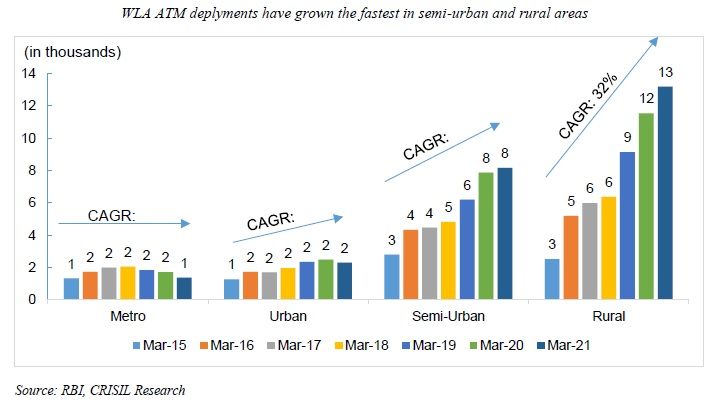
The Reserve Bank of India (RBI) has authorised non-bank entities to operate WLAs under the Payment & Settlement Systems Act of 2007. This initiative aims to expand ATM accessibility, particularly in rural and semi-urban regions, thereby enhancing financial inclusion and bridging gaps in service availability.
Operations of White Label ATM Operators in India
White Label ATM operators in India may appear similar to using any other ATM from the customer’s perspective, but the underlying processes are more intricate. WLA operators engage with three key intermediaries during transactions: a lending bank, a sponsor bank for settlement purposes, and an ATM network provider such as the National Payments Corporation of India (NPCI). These operators adopt a business-to-business (B2B) model by forming partnerships with banks. Their revenue and profitability are closely tied to the transaction volume at their ATMs, which also requires them to establish connections with end customers, akin to a business-to-consumer (B2C) approach.
Building relationships with potential customers is essential for WLA operators. They must foster awareness and trust regarding the safety and convenience of using White Label ATMs. This investment in customer trust is crucial for attracting users, increasing foot traffic at ATMs, and ultimately driving revenue growth. Alongside nurturing customer relationships, WLA operators must also cultivate strong ties with sponsor banks to ensure smooth operations and service delivery.
With the widespread adoption of UPI-Interoperable Cash Withdrawal (ICW), most WLAs in 2026 now allow customers to withdraw cash by scanning a QR code via their UPI app, reducing the need for physical debit cards. Revenue is primarily driven by transaction volume, making customer trust and awareness regarding safety essential for growth.
Usage of White Label ATM
White Label ATMs provide a range of facilities and services, including:
- Universal Access: Customers from any bank can utilize these ATMs.
- Free Transactions: Users are entitled to five free transactions each month.
- 24/7 Availability: These ATMs are operational around the clock, including on holidays.
- Value-Added Services: Mobile recharges, utility bill payments, and fast-tag top-ups.
- Transaction Limits: Users are entitled to free monthly transactions based on RBI guidelines. However, as of 1 April 2026, most major banks now count UPI-based cardless withdrawals at WLAs toward the customer’s monthly free limit.
History of White Label ATM Industry in India
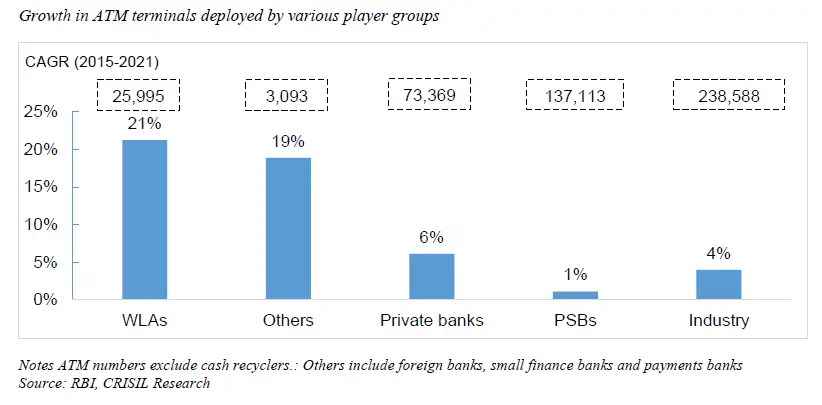
Until 2012, the establishment of ATMs in India was exclusively the domain of banks, with a total of 95,686 ATMs deployed by that time, primarily concentrated in urban and metropolitan areas. To improve ATM access in unbanked and underbanked regions, the Reserve Bank of India (RBI) allowed non-bank entities to set up, own, and operate ATMs in June 2012. This regulatory change led to the rise of White Label ATMs, which specifically target semi-urban and rural areas where there is limited penetration of bank-owned ATMs.
In 2013 and 2014, the RBI granted Certificates of Authorization to eight non-bank entities to establish and operate White Label ATMs across the country.
Read Also: Brown Label ATM – And 5 Other Amazing Types of ATMs You Didn’t Know About
WLA ATM Licenses by RBI
| Entity | Month and Year of Issuance of Certificate | Current Status as of April 2026 |
| Findi India (Formerly Tata Communications Payment Solutions) | May 2013 | Operational (Indicash) |
| Hitachi Payment Services | November 2013 | Operational (Money Spot) |
| Vakrangee Limited | January 2014 | Operational (Vakrangee Kendra) |
| India1 Payments | February 2014 | Operational (India1 ATM) |
| Muthoot Finance | February 2014 | Surrendered (2020) |
| SREI Infrastructure Finance | May 2014 | Surrendered (2020) |
| RiddiSiddhi Bullions | May 2014 | Revoked (2021) |
| AGS Transact Technologies | June 2014 | Revoked (2021) |
| Electronic Payment and Services | October 2024 | Operational & Scaling |
Read Also: TReDS Portal Meaning, Full Form, and all important points you need to know
Regulatory Tailwinds for WLA ATM Operators
In March 2019, the Reserve Bank of India (RBI) implemented a significant change to the business guidelines for White Label ATM (WLA) operators. This update enabled WLAs to directly source cash from the RBI, thereby reducing their dependence on bank withdrawals. As a result of this regulatory shift, the availability of cash in all denominations at these ATMs has improved, enhancing customer convenience and accessibility to cash.
Operating and maintaining ATMs can be quite expensive, with factors such as high interest rates and fuel costs further squeezing profit margins. The installation cost for an ATM typically reaches around INR 5,00,000, while monthly operational expenses hover around INR 50,000. In response to these financial pressures, the Confederation of ATM Industry (CATMI) has advocated for an increase in the interchange fee. They proposed raising the interchange fee to INR 17 for financial transactions and INR 6 for non-financial transactions.
In May 2025, the RBI reviewed the financial viability of WLA operators and approved a necessary hike in interchange fees to offset rising operational costs and inflation.
- Financial Interchange Fee: Increased to INR 19 per transaction (from INR 17).
- Non-Financial Interchange Fee: Increased to INR 7 per transaction (from INR 6).
- Customer Charges: Banks are now permitted to charge customers up to INR 23 per financial transaction once the free monthly limit is exhausted.
These revised fees have served as an incentive for operators to expand their networks into deep rural (Tier 5 and Tier 6) locations.
Read Also: What is NACH in Banking and How it is Revolutionizing Interbank Transactions in India
Number of White Label ATMs in India
As seen above, the white label ATM example includes machines installed by four companies. In total, these five companies have deployed over 35,983 ATMs in India. As of April 2026, total no. of White Label ATMs in India stands at 38,316.
| WLA operators | License approval date | Number of ATMs (2026) |
| India1 Payments Limited | 12 February 2014 | 15,146 |
| Hitachi Payment Services | 25 November 2013 | 11,870 |
| Findi India (Formerly Tata Communications Payment Solutions) | 3 May 2013 | 4,804 |
| Vakrangee | 23 January 2014 | 6,008 |
| Electronic Payment and Services (EPS) | 4 October 2024 | 488 |
As of 31 March 2026, India1 Payments holds the distinction of being the largest white-label ATM operator in India, with the deployment of 15,146 WLAs, branded as ‘India1 ATMs’. This achievement becomes more impressive considering that a majority of these ATMs have been installed in semi-urban and rural areas.
Hitachi Money Spot ATM is the brand associated with Hitachi Payment Services’ White Label ATM deployment in India. With a strong focus on deploying WLAs in Tier 3 to Tier 6 towns, the company has experienced remarkable growth in WLA deployment in recent years. Hitachi Money Spot and Indicash are two entities that have deployed a large number of ATMs in semi-urban and rural areas of India, with over 70% of their ATMs in these regions.
Tata Communications Payment Solutions (Now Findi India) holds the distinction of being the first company authorized by the RBI to open White Label ATMs in India. It launched its operations under the brand name ‘Indicash’ in June 2013 and notably inaugurated the first ATM in a Tier-5 town.
Electronic Payment and Services is currently the smallest of the five White Label ATM players in India. Despite its smaller scale, White Label ATMs remain a critical component of EPS business model, unlike other players that have more diversified business interests.
Growth of White Label ATMs in India
The growth of White Label ATMs (WLAs) in India is projected to experience a Compound Annual Growth Rate (CAGR) of 9.2% between 2024 and 2032. This expansion is largely attributed to the increasing demand for accessible banking services, particularly in semi-urban and rural areas where traditional bank-operated ATMs are less prevalent.
Region-wise WLA in India
WLA Operators’ Market Share by ATMs deployed
| India1 Payments Limited | 39.53% |
| Hitachi Payment Services | 30.98% |
| Findi India (Formerly Indicash) | 15.68% |
| Vakrangee | 12.54% |
| Electronic Payment and Services | 1.27% |
White Label ATM FAQs
Which is the biggest White Label ATM operator India?
India1 Payments is the largest white-label ATM operator in India, based on the number of ATMs installed as of 31 March 2026. The company’s network includes 15,146 WLAs.
Which is the first white label ATM in India?
Tata-group entity Tata Communications Payment Solutions (TCPSL) was the first company authorized by the RBI to open White Label ATMs in India. The company launched its ATMs under the ‘Indicash’ brand name in June 2013.
How does White Label ATM operator earn money?
WLA operators depend on intercharge fees for their revenues. This fee is charged to the card-issuing banks on every usage. Currently, the intercharge fee is INR 19 for financial transactions and INR 7 for non-financial transactions. Additionally, White ATM operators can offer value-added services and earn additional revenue.
How many transactions are free for users?
ATM users belonging to any bank can use WLA ATMs five times every month without paying any charges.
How many white label ATM operators are there in India?
As of April 2026, there are five white lable ATM operators in India.
How many types of cards can be used at a white label ATM?
ATM cum debit cards, credit cards and prepaid cards can be used at ATMs/WLAs for various transactions.
How many white lable ATMs are there in India?
According to data from NPCI, there are total of 38,316 WLA ATMs in India.
India1 Payments market share in White label ATM in India?
The market share of India1 payment stands at 39.53%.
Hitachi Payment Services market share in white label ATMs in India?
Hitachi Payment Services has a market share of ~31% in white label ATMs in India.
What is the market share of Findi India in white label ATM in India?
Findi India market share is around 15.7% in WLA ATMs in India.
What is the market share of Vakrangee in WLAs in India?
Vakrangee has a market share of 12.54% among the white label ATM companies in India.
which is the newest white label ATM operator in India?
Electronic Payment and Services (EPS) is the newest WLA operator in India.

Mahesh Yadav is a prolific writer with over a decade of professional experience. A person of wide interests, he found his true calling in the field of investing and specifically the stock market. He has an amazing skill of presenting the most complex financial concepts (and there is no shortage of complexity in investing) in simple language and terms.

