

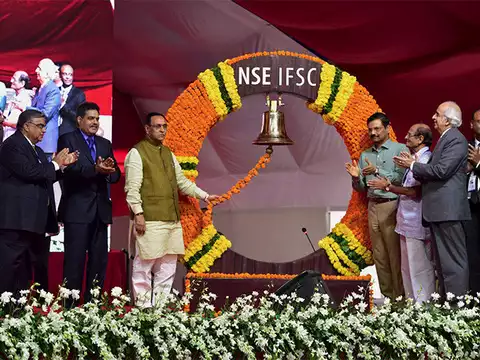
NSE IFSC Limited, popularly known as NSE International Exchange, is a wholly owned subsidiary of India’s National Stock Exchange (NSE). It was launched on 29th November 2016 after getting approval from the Securities and Exchange Board of India (SEBI) to set up an international exchange in Gujarat International Finance Tec-City (GIFT City) in Gandhinagar. In this article, we gain additional information about list of NSE IFSC registered brokers and how to trade US stocks in India legally.
The primary goal of NSE IFSC is to expand financial markets and attract foreign capital into India. Under the GIFT IFSC framework, exchanges can conduct transactions in foreign currencies beyond the Indian Rupee, facilitating international investment in Indian securities.
Substantially, all trading and settlement activities on the NSE IFSC platform are conducted in US dollars, minimizing currency fluctuations. This creates a stable, predictable environment that benefits international investors trading in Indian stocks.
NSE IFSC: GIFT City
GIFT City is located in Gujarat and is a special economic zone where stock exchanges can trade in currencies other than the Indian Rupee. It facilitates trading in various financial instruments, including foreign equity shares, depository receipts, and derivatives, subject to SEBI approval.
Direct listings have started in GIFT City, and now Indian companies have access to global capital. Besides this, the government is positioning GIFT City as a hub for carbon credit trading and is looking to integrate sustainability into its financial framework.
Also, the finance ministry has reduced the minimum public offering requirement from 25% to 10%, making it easier for companies to list internationally and attract foreign investment. IFSCA regulates GIFT City which is growing rapidly with multiple exchanges and many financial entities.
Read Also: NSE Unlisted Share Price
Are Indian Retail Investors Allowed to Trade in GIFT City?
Indian retail investors can invest and trade in financial instruments in GIFT City, provided they comply with the regulations under the Foreign Exchange Management Act (FEMA). To be eligible for these investments, one has to be a resident of India. Under the Liberalized Remittance Scheme (LRS), they can remit up to USD 2,50,000 (INR 2.15 crore) per financial year for various investment activities including buying stocks and setting up joint ventures. However, funds remitted under LRS cannot be used for trading in margined products or derivatives.
To trade in GIFT City, investors need to open a Demat account with a broker registered with the NSE International Exchange. The city offers a wide range of financial instruments including shares, bonds, mutual funds and government securities, all of which are traded in foreign currencies.
Also, recent regulations have made investments more attractive. These include relaxing the cap on fund exposure to group company stocks and reducing the minimum ticket size for bond investments. With tax benefits for certain investment activities, GIFT City is looking more attractive as a global financial hub. It provides Indian retail investors with more investment opportunities.
Accessing US Stock Markets: Opportunities for Indian Investors
Investors can trade in equity, currency and commodity derivatives at NSE IFSC, but the main attraction of NSE IFSC is that investors can trade in US stocks. The exchange offers investments in 50 top US companies like Amazon, Apple, Microsoft, Alphabet (Google), Netflix, Meta (Facebook), Walmart, and Tesla. These stocks are not listed in India but are available through unsponsored depository receipts.
Unsponsored depository receipts are operated by market makers acquiring shares in the United States and issuing receipts based on these holdings. Since these are unsponsored receipts, there is no involvement or consent from the companies whose stocks are being traded. Known as NSE IFSC receipts, these instruments enable investors to engage in trading activities through registered brokers with NSE IFSC. Essentially, these receipts confer a proportionate beneficial interest in the underlying shares of the respective U.S. companies.
This structure not only simplifies access to U.S. stocks but also allows for fractional ownership, making investments more affordable for retail investors. Furthermore, all trades conducted through NSE IFSC will be governed by a robust regulatory framework ensuring transaction security and investor protection.
NSE International Exchange: How to Trade US & Global Stocks in 2026
- Select a Registered Broker: Choose from the expanded list of 61 brokers (ensure they offer the “Global Access” platform).
- LRS Remittance: Under the Liberalized Remittance Scheme (LRS), you can remit up to USD 250,000 per year. In 2026, many banks have integrated “One-Click Remittance” to GIFT City accounts.
- Digital KYC: Complete your verification via DigiLocker.
- Trade in USD: All trades are settled in USD on a T+1 cycle, meaning your funds or stocks are settled within one business day.
Through the newly launched Global Access Platform, Indian retail investors can now trade in over 30 international markets, including the UK, Japan, Germany, and Canada. The system has moved beyond fixed receipt ratios. Investors can now purchase as little as 0.01 of a share or invest a fixed dollar amount (e.g., USD 10) directly through the platform. Onboarding was also streamlined using DigiLocker and Video KYC, allowing accounts to be activated in under 10 minutes.
Under the traditional model, high-value stocks were available via IFSC Receipts with fixed ratios (e.g., 10 receipts for 1 share). However, in 2026, the platform allows for Precision Fractional Trading.
If an investor wants to buy one full share of Apple Inc. at its current price of USD 266.43, they would require approximately INR 24,850 (assuming an exchange rate of ~INR 93.25). Instead of needing the full amount, a retail investor can now invest as little as USD 5 (approx. INR 465) to own a fraction of that same Apple share.
This dollar-based investing model removes the barrier of high stock prices. Whether it is a high-priced tech giant like Nvidia or a legacy stock like Berkshire Hathaway, retail investors can now build a diversified global portfolio with small, manageable amounts, all while staying within the Liberalised Remittance Scheme (LRS) limits.
Read Also: Nifty Auto Stocks List With Weightage
- Depository Receipts (DRs) are a mechanism used by companies listed in one country to attract investors and facilitate trading in another country’s exchanges. DRs can be sponsored or unsponsored depending on the involvement of the company.
- In the context of NSE IFSC, the DRs that trade on its global platform are unsponsored. This means that the depository receipts are not directly issued by the companies themselves. Instead, NSE IFSC collaborates with an international custodian (HDFC Bank IBU, in this case) to act on its behalf. The custodian holds the shares of the listed companies in the United States and then issues DRs to the depository account in India.
- Subsequently, these unsponsored DRs are listed on the NSE global platform, enabling investors to trade them. To ensure smooth and active trading, NSE IFSC has partnered with significant market makers. These market makers provide two-way quotes on the exchange, allowing for trading with low-impact costs. Market makers would need to park the shares with the international custodian before providing sell quotes.
NSE IFSC Registered Brokers
Before we get into the details of trading US stocks on the NSE International Financial Services Centre (NSE IFSC), it is important to understand the role of NSE IFSC registered brokers in this framework. Currently, 61 brokers are registered with NSE IFSC, giving investors access to global markets. Anand Rathi, Emkay, HDFC, Motilal Oswal, and SMC Global are some of the popular brokers for NSE IFSC. However, notable platforms like Zerodha and Upstox have not yet secured registration with the international exchange.
| Broker-Dealer Code | Broker Dealer Name | Broker Dealer Code |
|---|---|---|
| 1 | NUVAMA CAPITAL SERVICES (IFSC) LIMITED | 10001 |
| 2 | ASHIKA STOCK BROKING IFSC PRIVATE LIMITED | 10006 |
| 3 | SYNERGY DEALCOM (IFSC) PRIVATE LIMITED | 10011 |
| 4 | ESTEE IFSC PRIVATE LIMITED | 10019 |
| 5 | SHARE INDIA SECURITIES (IFSC) PRIVATE LIMITED | 10020 |
| 6 | SMC GLOBAL IFSC PRIVATE LIMITED | 10021 |
| 7 | GLOBE CAPITAL (IFSC) LIMITED | 10022 |
| 8 | PACE FINANCIAL (IFSC) PRIVATE LIMITED | 10024 |
| 9 | GOLDMINE IFSC PRIVATE LIMITED | 10027 |
| 10 | SIHL GLOBAL INVESTMENTS (IFSC) PRIVATE LIMITED | 10029 |
| 11 | Arya Fin Trade IFSC Private Limited | 10032 |
| 12 | INDO THAI GLOBE FIN (IFSC) LIMITED | 10034 |
| 13 | DOLAT CAPITAL IFSC PRIVATE LIMITED | 10035 |
| 14 | JAINAM IFSC MAVENS PRIVATE LIMITED | 10036 |
| 15 | TRADEAIR (IFSC) PRIVATE LIMITED | 10037 |
| 16 | RSL IFSC PRIVATE LIMITED | 10038 |
| 17 | PLUSTRADE HOLDING (IFSC) PRIVATE LIMITED | 10039 |
| 18 | STOCKHOLDING SECURITIES IFSC LIMITED | 10040 |
| 19 | DAGA BUSINESS (INTERNATIONAL) STOCK BROKERS (IFSC) PRIVATE LIMITED | 10041 |
| 20 | EMKAYGLOBAL FINANCIAL SERVICES IFSC PRIVATE LIMITED | 10042 |
| 21 | RAGHUNANDAN CAPITAL (IFSC) PRIVATE LIMITED | 10043 |
| 22 | MOTILAL OSWAL FINSEC IFSC LIMITED | 10044 |
| 23 | PHILLIP VENTURES IFSC PRIVATE LIMITED | 10045 |
| 24 | Bloomfield International Securities (IFSC) Limited | 10046 |
| 25 | FINDOC INVESTMART (IFSC) PRIVATE LIMITED | 10047 |
| 26 | ANAND RATHI INTERNATIONAL VENTURES (IFSC) PRIVATE LIMITED | 10048 |
| 27 | HDFC BANK LIMITED IFSC BANKING UNIT (IBU) | 10049 |
| 28 | EVERMORE GLOBAL (IFSC) PRIVATE LIMITED | 10050 |
| 29 | STAR FINVEST (IFSC) PRIVATE LIMITED | 10052 |
| 30 | KOTAK MAHINDRA BANK (IBU) | 10053 |
| 31 | SGX INDIA CONNECT IFSC PRIVATE LIMITED | 10054 |
| 32 | ICICI BANK LIMITED (IBU) | 10055 |
| 33 | STOCKHOLDING CORPORATION OF INDIA LIMITED (BRANCH) | 10057 |
| 34 | Bonanza Portfolio (IFSC) Private Limited | 10058 |
| 35 | Appreciate Broking IFSC Private Limited | 10059 |
| 36 | East India IFSC Private Limited | 10060 |
| 37 | Geojit IFSC Limited | 10061 |
| 38 | Axis Bank Limited IBU | 10063 |
| 39 | Quadeye IFSC Private Limited | 10066 |
| 40 | IVIK Securities (IFSC) LLP (Formerly known as IVIK Securities (IFSC) Private Limited) | 10067 |
| 41 | Junomoneta International IFSC Private Limited | 10068 |
| 42 | Abans Global Broking (IFSC) Private Limited | 10071 |
| 43 | INDmoney Global (IFSC) Private Limited | 10073 |
| 44 | RARU Capital IFSC Private Limited | 10074 |
| 45 | K2J Global (IFSC) LLP | 10075 |
| 46 | InBrok (IFSC) Private Limited | 10077 |
| 47 | Jaypee Capital Services IFSC Pvt Ltd | 10078 |
| 48 | Purplesigma Services IFSC Private Limited | 10079 |
| 49 | ViewTrade International IFSC Private Limited | 10080 |
| 50 | SentinalSec IFSC LLP | 10081 |
| 51 | ISTAA Capital Markets (IFSC) Private Limited | 10082 |
| 52 | Vardhamanglobal IFSC Private Limited | 10083 |
| 53 | Amrapali Industries Global IFSC Ltd | 10084 |
| 54 | Zincmoney IFSC Private Limited | 10085 |
| 55 | Achintya IFSC Private Limited | 10086 |
| 56 | Betafront Securities (IFSC) Private Limited | 10087 |
| 57 | Quantstreet Global IFSC LLP | 10088 |
| 58 | Aadishakti Global IFSC LLP | 10089 |
| 59 | AWM Broking (IFSC) Private Limited | 10090 |
| 60 | THINKTANK IFSC PRIVATE LIMITED | 10091 |
| 61 | HDFC Securities IFSC Limited | 10097 |
Key Points About NSE’s Global Exchange
- IFSC Receipts:
- NSE IFSC receipts are fractional representations of US stocks. For example, 50 receipts may represent one share, or 100 receipts could equal half a share of a listed US company. This fractional structure makes it easier and more affordable for Indian retail investors to participate in global equity markets.
- Market Timings:
- The NSE IFSC operates extended trading hours split into two main sessions across various product segments. For index futures and options, trading starts with a pre-open at 6:15 AM IST, and the regular session runs from 6:30 AM to 3:40 PM. The second session begins at 4:35 PM and continues until 2:45 AM the next day. For single stock derivatives and index options, similar two-session timing applies.
- Currency derivatives, debt securities, and depository receipts have slightly different schedules: the first session runs from 6:30 AM to 5:00 PM, and the second session resumes from 5:30 PM until 2:45 AM.
- Specifically for NSE IFSC receipts (which enable trading in US stocks), the market is open from 7:00 PM to 1:30 AM IST.
- Block trades under the NLT mechanism are allowed from 6:30 AM to 4:55 PM, and again from 5:10 PM to 2:45 AM.
- The FUTCBI segment operates from 9:00 AM to 5:00 PM. Across all segments, trade modification and collateral limit updates generally close five minutes after the market ends.
- Price Movement:
- The minimum price tick on NSE IFSC is USD 0.01, allowing for fine-grained movements in security prices and tighter spreads for investors.
Interested in NSE? More Articles For You
NSE IFSC: Membership Categories
NSE provides four types of membership at its international exchange. Members are chosen through a rigorous and transparent process to ensure the smooth and secure operation of the exchange systems.
| Trading Member | This category of membership allows a member to trade on his account as well as on behalf of his clients but clearing and settlement of trades executed through the Trading Member would have to be done through a Trading-cum Clearing Member or Professional Clearing Member of the NSE IFSC Exchange. |
| Trading Cum Self Clearing Member | This category of membership entitles a member to execute trades and to clear and settle the trades executed on his account as well as on the account of his clients. |
| Trading Cum Clearing Member | This category of membership entitles a member to clear and settle trades of such members of the NSE IFSC Exchange who choose to clear and settle their trades through this member. |
| Professional Clearing Member | This category of membership entitles a member to clear and settle trades of such members of NSE IFSC Exchange who choose to clear and settle their trades through this member. |
Membership Process of NSE International Exchange
- Incorporate a company in GIFT SEZ
- Apply GIFT SEZ-IFSC & obtain approval from the Development Commissioner
- Submission of application to NSE IFSC / NSE IFSC CC
- Grant of NSE IFSC Exchange/CC offer letter subject to SEBI Approval
- Onward submission by NSE IFSC to SEBI for registration
- Grant of SEBI Approval
- Forward the SEBI certificate to the member
- Submit enablement documents
- Member enabled on the Trading system
This was all about investing in US stocks from India through NSE’s global platform.
Recent Developments
- NSEIX signed a strategic MoU with the Cyprus Stock Exchange to enable cross and dual listings and enhance bilateral capital market collaboration during Prime Minister Modi’s visit to Cyprus.
- In March 2026, XED, a global edtech firm, successfully concluded the first-ever USD-denominated IPO on NSEIX, marking a new era for primary market listings in GIFT City.
- Effective April 2026, the government has enabled a tax-neutral relocation for offshore Mutual Funds and ETFs into GIFT City, which is expected to bring billions of dollars in AUM back to Indian shores.
- Following the listing of green bonds by Sri Lanka’s DFCC Bank, NSEIX has become a hub for ESG-linked debt in the Global South.
- Shri Suresh Menon, a veteran regulator with three decades of experience at SEBI, currently serves as a Public Interest Director, ensuring high standards of governance.
- Following the transition of SGX Nifty to GIFT Nifty, it achieved an all-time high monthly turnover of USD 129.80 billion (~INR 10.85 lakh crore) in March 2026, reflecting strong global investor interest.
- Shri. Suresh Menon, a veteran regulator with 30 years at SEBI, was appointed as Public Interest Director on the NSE International Exchange board.
- NSEIX launched the first-ever fixed income derivatives in IFSC on the Nifty Bharat Bond Indices, expanding risk management tools for bond market exposure.
Conclusion
The NSE IFSC provides a distinctive opportunity for Indian investors to engage in trading US stocks with fractional ownership, enhancing accessibility and affordability. Situated in GIFT City, a special economic zone regulated by the International Financial Services Centres Authority (IFSCA), NSE IFSC creates a favorable environment for international financial activities. This platform allows retail investors to diversify their portfolios and get exposure to global markets.
For those looking for investment avenues beyond the domestic market, NSE IFSC is a good option to participate in the growth of US companies while hedging currency fluctuations. With the ability to invest in well-known US stocks through unsponsored depository receipts, investors can benefit from this innovative structure without the need for substantial capital outlay typically associated with direct stock purchases.
NSE IFSC Trading In US Stocks FAQs
Can Indian retail investors trade in US stocks at NSE IFSC?
Yes, resident Indians can invest and trade in US stocks at NSE IFSC. However, they must comply with FEMA regulations and can invest up to USD 2,50,000 (INR 2.15 crore) per year via LRS.
What is the significance of NSE IFSC receipts?
NSE IFSC receipts represent unsponsored depository receipts that allow investors to trade US stocks with fractional ownership, making it more affordable.
What is the role of market makers in NSE IFSC?
Market makers provide liquidity and two-way quotes for trading US stocks on NSE IFSC’s platform, ensuring efficient transactions with low impact costs.
How many brokers are there in NSE IFSC broker list in India as of 2026?
As of 2026, NSE IFSC has over 61 registered brokers, including Anand Rathi, Emkay, HDFC, Ind Money, Motilal Oswal, and SMC Global.
What is the NSE IFSC full form, and where is it located?
NSE IFSC stands for National Stock Exchange International Financial Service Centre, located in GIFT City, Gujarat, enabling Indian investors to trade globally in foreign currencies.
Can I trade in Global Markets other than the US in India?
Yes, the NSEIX Global Access platform has started rolling out access to 30 global markets, including major European and Asian exchanges.
Is a Demat account mandatory for global trading at NSEIX?
For the new Global Access platform, a traditional demat account is not required, simplifying the process for retail investors. However, for Unsponsored Depository Receipts, a specialized GIFT City demat account is used.
What was the GIFT Nifty turnover in March 2026?
It reached a record-breaking USD 129.80 billion, reflecting the highest level of international participation since the exchange’s inception
When did NSE IFSC start trading?
NSE IFSC which launched trading on June 5th, 2017, offers USD denominated trading in various products
Who is the NSE IFSC Receipts Custodian?
HDFC Bank IBU will be acting as the NSE IFSC Receipts Custodian.


